
South African auto component makers already meet export quality. The next barrier is whether a buyer in Detroit, Stuttgart or Tangier can find them when searching on AI
By Charles Smith, Managing Director of CSA Digital (Pty) Ltd
South Africa’s automotive component manufacturing industry already produces parts that meet global requirements. However, too many local factories lack a digital footprint that AI platforms are able to understand, trust and recommend. This gap now sits between local plants and new export markets such as the United States, Europe and fast-growing African hubs such as Morocco.
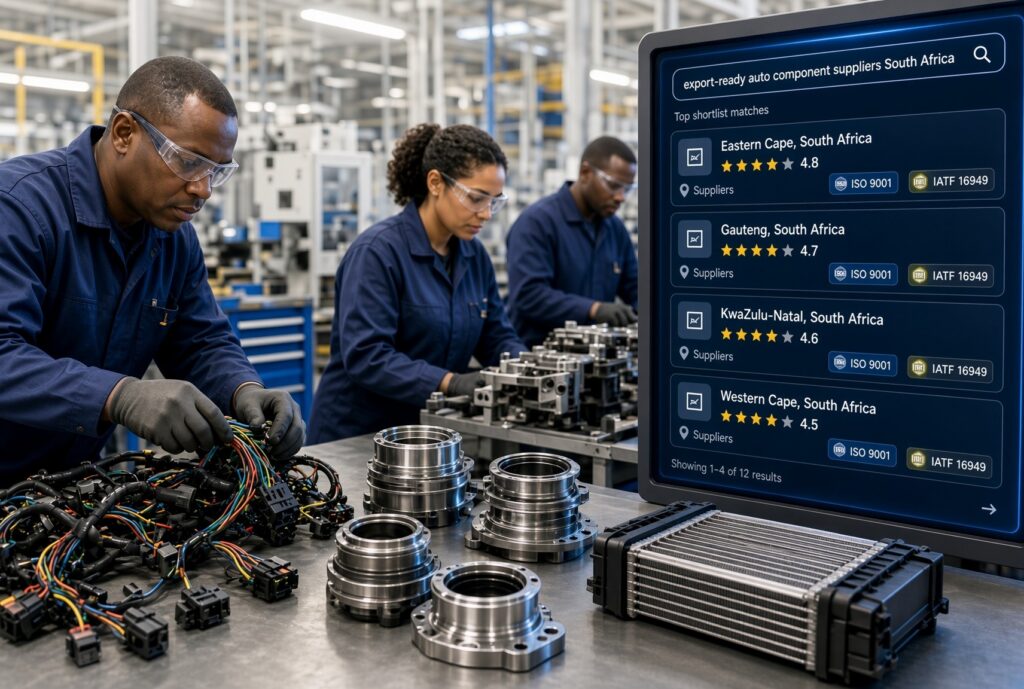
Procurement teams no longer start searches only on Google. They ask ChatGPT, Grok, Gemini, Copilot and Perplexity for shortlists: who makes wiring harnesses in South Africa, who can supply thermal parts for new-energy vehicles, who is export-ready into the EU and GDPR-compliant? AI searches don’t return a list of paid links but will summarise what has been written about the company found on its website, in directories, reviews, news articles, press releases and structured data.
If an AI platform cannot find consistent facts about your organisation, it will recommend a competitor it understands better. Unlike Google Search, AI rankings are not bought with advertising spend. This is an opening for local manufacturers who cannot outbid large manufacturers on their Google Ad spend. It is therefore important for manufacturers to provide clear details on their website, in press articles and on LinkedIn, as well as other digital platforms, where AI can easily access the information.
The export case is urgent
Local manufacturers are operating in a tight market. Plant closures and job losses have already shown how quickly volume disappears when OEM programmes shift.
The United States has become harder, not easier, to do business with. Section 232 tariffs of 25% on imported vehicles and components have undercut AGOA’s paper benefit. Europe remains a primary export market, and it is moving toward low- and zero-emission platforms.
In Africa, countries like Morocco are not distant competitors, some are building into Europe’s extended supply base, with Stellantis targeting high local content and multi-billion-euro supplier spend. Under AfCFTA automotive rules of origin, qualifying product needs at least 40% African content, a rule that rewards suppliers who can be found, verified and contracted across the continent.
Quality is not the only criteria. A Tier 1 buyer in Germany or a programme manager in Kenitra will not shortlist a plant they cannot verify. If the company name, address, product range, certifications, leadership and export capability are not clear on the website, Google Business Profile, LinkedIn and directories, AI treats the business as unclear and moves on.
What AI actually looks at
Many manufacturers cannot compete on Google advertising because of the high advertising cost. Grok, when asked to produce a shortlist, looks at reviews, verified ratings, professional registrations and evidence of reliability. In components, the equivalent signals are IATF 16949 and ISO credentials, OEM programme history, export markets served, NEV-relevant capability, plant location and recent media coverage generated by press releases. Media articles also form the backbone of AI searches while social media’s share is rising and important.
There is still no large-scale advertising product that can buy prominence in an AI search like Google does which is a huge positive. Prominence in AI searches can be more easily attained by improving website and digital visibility. If a website is slow, poorly structured or hard to crawl, the company loses twice, in Google search rankings and in AI searches.
While Google has not gone away and still drives the bulk of website traffic, search habits are changing with AI being used more frequently.
GDPR – Export markets also bring privacy rules
It is important to note that digital visibility for exporters is not only a content problem. GDPR applies the moment a South African firm markets to EU buyers, even if the factory is based in South Africa. POPIA already governs local data. China’s PIPL is stricter for companies chasing EV-related work. Clean consent, accurate tracking and a site that does not drop advertising or analytics cookies before permission is given are now part of market entry, not a nice-to-have item. These requirements are crucial and non-compliance could result in thousands of euros in fines.
Practical steps for component manufacturers
It is therefore important to treat AI-SEO in a similar way to Google SEO: as a commercial discipline, not a website afterthought. Ask ChatGPT, Grok, Gemini and other AI platforms about your company, its products and competitors. If the answer is thin or wrong, that is the brief. Our organisation provides AI-optimisation as a service, as well as press release writing, GDPR-compliance, social media, SEO and Google ads.
Our organisation can assist in publishing a clear, plain-English description of what the plant makes, for which vehicle platforms and the markets it supplies. Repeat those exact business details on the website, LinkedIn, directories and the email signature. Different trading names will confuse AI.
Keep the legal name, address, leadership and certifications identical everywhere. Add FAQ pages to the website that answer the questions a buyer will ask: capabilities, quality systems, lead times, localisation, NEV readiness.
Issue press releases and put the full text on the website. Image-only PDFs are largely invisible to Google and to AI. Post regularly on LinkedIn. AI increasingly learns from professional social content, and this is where export buyers already look for suppliers.
Ask OEM and Tier 1 customers for detailed, recent testimonial reviews and published case references where contracts allow.
Being AI-visible is the new baseline for being findable. Traditional SEO still matters because Google still starts most buying journeys. AI-SEO is what decides whether a high-quality South African component plant is even in the conversation when a buyer in the US, Europe or Morocco asks who can supply the part.
Ends
Notes to editors
CSA Digital (Pty) Ltd is a Johannesburg digital marketing and communications agency. It specialises in website development and maintenance, AI-SEO, press release writing and issuing, social media, GDPR/POPIA compliance and digital strategy for industrial, mining, automotive and member-association clients.